|
Science In A Tree
Climb a Tree and Learn Cool Science | ||||||
|
|
Program Summary
| |
|
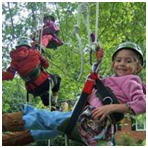
What is Science in a Tree? Science in a Tree is an outdoor adventure education program designed for students from grades K to 12. We travel to local schools to deliver a unique on-campus event combining recreational tree climbing, adventure learning, and experiential science education. The kids will enjoy the excitement of climbing safely up a tree along with the challenge of doing cool science experiments along the way. Climb a tree and learn cool science! It doesn't get any better than that. The Science in a Tree program was built with the students and teachers in mind. We focus on science activities and topics that can't be studied properly in the classroom. Our experts work directly with the schools before, during, and after the event to deliver content that matches the educational goals of the teachers. We offer a range of science lessons at the elementary, middle, and high school levels covering topics such as gravity, air resistance, pendulum motion, seed dispersal, and photosynthesis. |
|
| Examples of Previous Events: | |
|
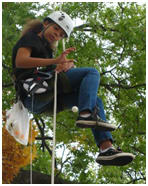
MRH Middle School: A student drops a ping pong ball from 40 feet in the air. At MRH Middle School in Maplewood, the students ran experiments on gravity, free-fall, and pendulum motion. The picture shows one of the kids hanging 40 feet in the air having just released a ping pong ball, which you can see by her right foot. Her partner scientist is on the ground using a stopwatch to measure the flight time. The day's activities were later presented at the Association for Experiential Education national conference by Guy Mott from Adventure Tree and Bill Henske & Scott McClintock, two of the science teachers at MRH Middle School. |
|
|
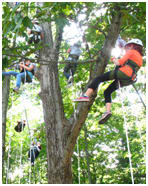
The College School: Students explore the tree as they learn about nutrient
transport. This picture is from an event with The College School in Webster Groves, where the students were studying water & nutrient transport in trees as part of their 4th grade science curriculum. Several climbers are seen exploring the different parts of the tree as they learn how essential nutrients are collected and transported around from place to place. Not seen are the scientists on the ground who were building water molecules and experimenting with cohesive forces and the capillary effect in our outdoor classroom. |
|
|
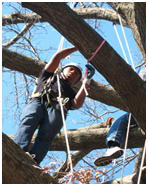
EarthDance Farms: A student measures the size of a limb to determine its
carbon content. At EarthDance Farms in Ferguson, the students learned about carbon sequestration, photosynthesis, and the importance of trees in maintaining a healthy Earth. The picture shows one of the climbers as he measures the circumference of a large branch. The data on tree dimensions was then used to calculate the weight of the tree and determine its carbon content. The kids also built molecular models to demonstrate how trees use water & carbon dioxide to create the carbohydrate molecules that store the carbon. |
|